Professional Chauffeur Etiquette: What Every Discerning Traveler Should Expect
The gap between a good driver and a true chauffeur is not the vehicle or the uniform — it is a complete understanding of how to make a client's journey feel effortless and private.
Opulent Transport
Opulent Transport · South Florida
Why Etiquette Is Not Soft — It Is Operational
The word etiquette tends to conjure images of table manners and formal correspondence. In the context of luxury ground transportation, it is something far more practical: a set of learned behaviors and habits that determine whether a client's journey is genuinely excellent or merely adequate. Professional chauffeur etiquette is not a list of niceness rules. It is a complete operating philosophy that covers communication, vehicle presentation, driving conduct, time management, and discretion — each element as important as the others.
For clients who use luxury transportation regularly, these standards are not aspirational. They are the baseline expectation. Understanding them in detail helps you evaluate providers before you book and helps you articulate your expectations clearly when something falls short.
Before the Pickup: Communication and Confirmation
Professional chauffeur service begins well before the vehicle arrives. Twenty-four hours before a scheduled pickup, the client or their travel manager should receive a confirmation that includes the chauffeur's name, direct contact number, vehicle description (year, make, model, color, and plate number), and the confirmed pickup location and time. This is not a courtesy — it is a standard operating procedure that protects both the client and the provider from avoidable confusion.
On the day of service, the chauffeur should make contact approximately fifteen minutes before arrival to confirm they are en route and that the pickup details remain unchanged. This contact should be brief and informative — not a conversation, but a professional check-in that gives the client confidence without requiring a response if they are occupied.
What you should never experience: a chauffeur who is already waiting and has not communicated, a driver who calls multiple times to ask clarifying questions that should have been resolved at booking, or a vehicle that arrives late without proactive communication about the delay and a revised ETA.
The Arrival and Greeting
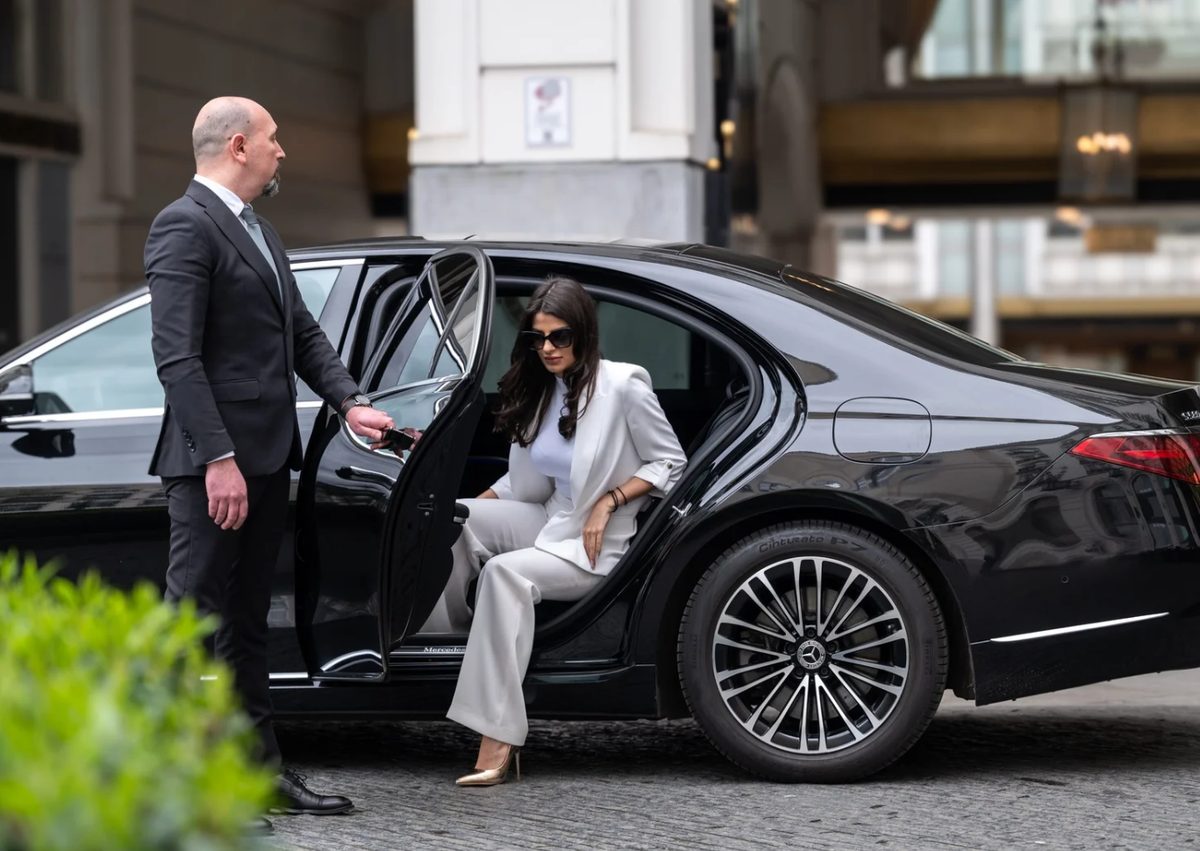
When a professional chauffeur arrives at a pickup location, they are positioned beside the vehicle — not inside it — holding a name placard if the pickup is at a hotel, airport, or event venue where multiple drivers may be present. The placard should be discreet: a small, professional card with the client's surname or the company name, not a handwritten sign or a phone screen held at arm's length.
The greeting should be direct and warm without being familiar. "Good evening, Mr. [Name] — I'm [First Name], your chauffeur this evening" is appropriate. First names on both sides at a first meeting, without invitation, is not. The chauffeur opens the rear door for the client, handles any luggage without being asked, and does not initiate a conversation beyond confirming the destination.
A common and easily avoided error is the chauffeur who begins the engagement by commenting on traffic, the weather, or the difficulty of finding the address. These observations put the client in the position of managing the chauffeur's experience rather than relaxing into their own. A professional handles the logistics silently and communicates only what the client needs to know.
Inside the Vehicle: The Standard of Silence
The interior of a professional chauffeur vehicle should be temperature-controlled before the client enters — not adjusted after they comment that it is warm. Chilled still water should be available without the client needing to ask. If the client has specified preferences at booking (sparkling water, a particular temperature, music or silence), those preferences should be in place before the vehicle moves.
The default assumption of every professional chauffeur is that the client prefers silence. If the client initiates conversation, the chauffeur responds naturally and engages genuinely. If the client does not, the chauffeur does not fill the silence with commentary. The radio, if on at all, should be set to something unobtrusive and at a volume that cannot be heard at normal conversation levels.
A client who is on a phone call should never be able to hear the chauffeur's breathing, movement, or background noise. A client who is working should not be interrupted. A client who falls asleep should be allowed to sleep and gently notified — not startled — when they are approaching the destination.
Driving Conduct: Composure Is the Standard
Professional chauffeur driving is not aggressive even when traffic demands efficiency. It is smooth, anticipatory, and unhurried in feel even when maintaining a brisk pace. The quality of a chauffeur's driving is most evident in three areas: braking, lane changes, and roundabout and turn execution.
Hard braking is almost always a sign of inattention — a failure to read the traffic situation far enough ahead to modulate speed gradually. A professional chauffeur brakes early and gently, and the client should rarely feel the seatbelt tighten. Lane changes are deliberate and fully signaled, without the rapid lateral movements that signal either aggression or anxiety. Turns are taken at the correct speed for the radius, without the client feeling momentum shift.
What should never happen: a chauffeur who cuts off other vehicles to save thirty seconds, who expresses frustration at traffic through visible or audible signs, who uses a phone — including a hands-free device — for personal calls during the trip, or who makes routing decisions that are clearly suboptimal without explaining why.
Luggage, Doors, and Physical Assistance
The chauffeur manages all luggage — retrieval from a location, loading into the vehicle, and delivery to the destination — without being asked. They do not wait for the client to indicate that luggage needs to be handled; they handle it as a matter of course. Heavy or bulky items are managed without complaint or commentary.
Doors are opened for the client at both the pickup and the drop-off. The chauffeur positions themselves to open the correct door — the one closest to the building entrance, or the one that presents the least exposure to weather or traffic — without needing instruction. At the drop-off, the chauffeur opens the door, retrieves luggage, confirms that the client has everything they brought, and does not close the vehicle door until the client has moved clear.
If the client requires physical assistance — due to age, injury, or the logistics of a formal gown in a low vehicle — that assistance is offered once, quietly, without drawing attention to the need.
Discretion: What Happens in the Vehicle Stays There
Every conversation, document, phone call, and personal detail that a client reveals during a journey is confidential. A professional chauffeur does not discuss clients with other clients, with colleagues except as operationally necessary, or with anyone outside the organization. They do not mention having transported a particular person unless that person has made it publicly known. They do not comment on anything they observed during a trip.
This standard of discretion applies not only to explicit conversation but to everything the chauffeur encounters in the course of the engagement: the nature of the client's meeting, the identity of the people they meet, the items they carry, and any personal behavior or circumstances they reveal. A professional chauffeur treats all of this as though it did not happen.
At Opulent Transport, our chauffeurs sign formal confidentiality agreements as part of their engagement with our company. Discretion is not a personality trait we select for — it is a contractual obligation we enforce. If you would like to discuss our confidentiality infrastructure for corporate accounts, we are glad to do so.
The Drop-Off and Close
The engagement ends at the drop-off, not when the vehicle stops. The chauffeur positions the vehicle to minimize the client's exposure to weather, traffic, and distance to the entrance. They open the door, retrieve luggage, confirm the client has everything, and offer a brief, genuine close — "Safe travels, Mr. [Name]" — without lingering or extending the interaction beyond what is natural.
After the trip, the chauffeur performs a post-trip inspection of the vehicle interior, notes any items left by the client, and contacts the client directly (or through the booking office) if anything was left behind. A forgotten phone, laptop, or document is returned through a verified handoff — not left at a front desk or entrusted to a third party without confirmation.
These standards, taken together, define what professional chauffeur service actually looks like when it is done well. They are the result of training, organizational commitment, and a genuine understanding of what executive clients require. To experience them firsthand, book with Opulent Transport for your next South Florida journey.
Ready for a different kind of ride?
Book your black car service today. Use code RIDE10 for 10% off your first booking.
The Opulent Journal
Priority booking access & exclusive rates
Subscribe for insider guides, first access to seasonal offers, and our client newsletter. Use code RIDE10 for 10% off your first booking.
No spam. Unsubscribe anytime.